Build the physical model.
Create or import geometry, prepare charging surfaces, and assign materials and conductors. Keep source CAD distinct from the computational mesh.
GEOMETRY · MATERIALS · MESHING equipotentiallab.
We develop TASC: an AI-driven spacecraft charging app
designed for rapid analysis and to save months of work.
An illustrative two-charge model.
Switch the charges to explore the contours.
TASC is an AI-driven spacecraft charging app for rapid spacecraft charging analysis. It brings geometry, surface materials, electrical connections, environments, and numerical solvers into one engineering workflow.
Explore how a design charges, where differential potentials develop, and how material or electrical changes affect the result. Inspect the assumptions alongside the fields they produce.
Inside the TASC application
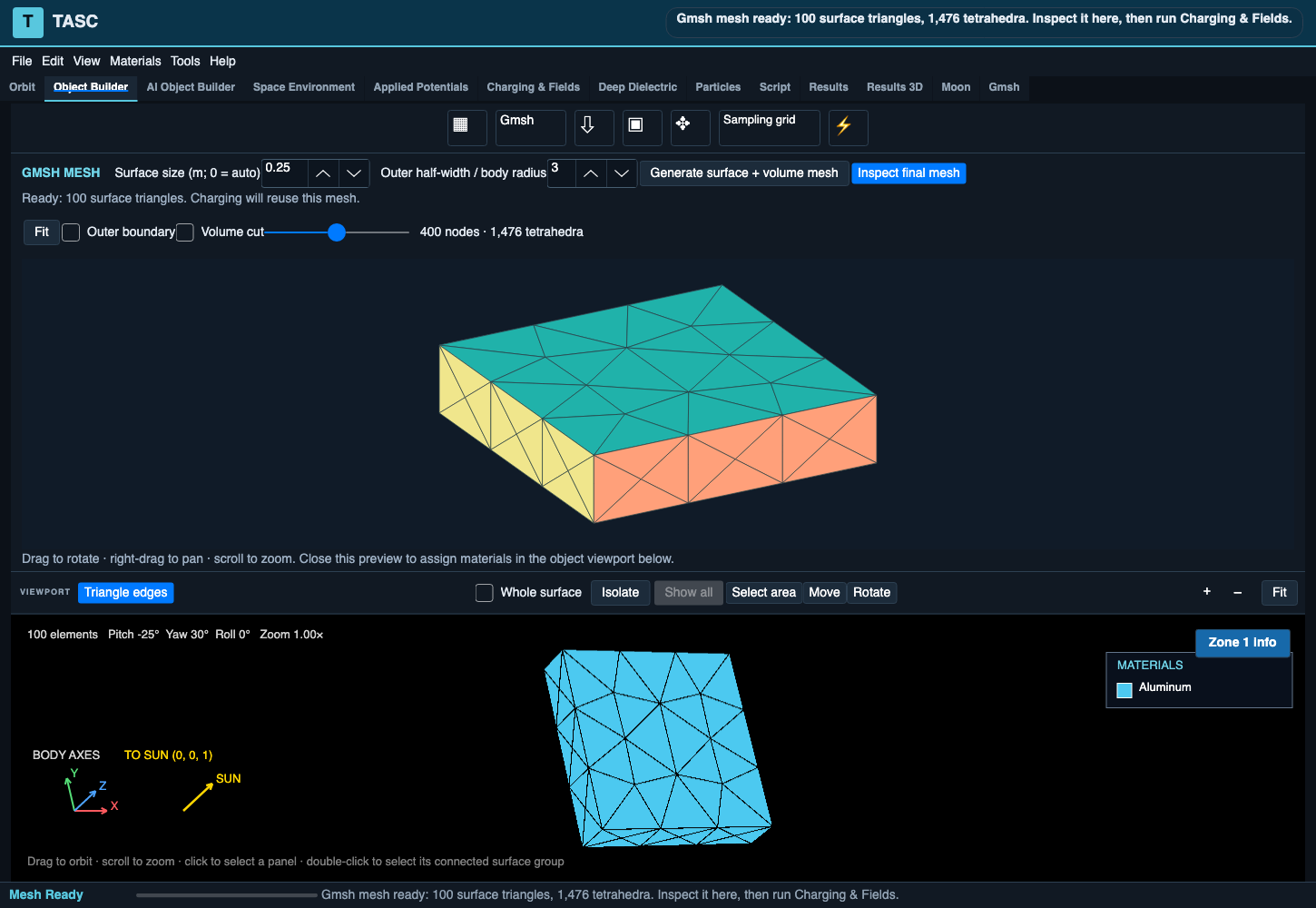
A saved lander example
Ask about geometry, materials, and the next steps in model preparation within TASC’s AI Object Builder.
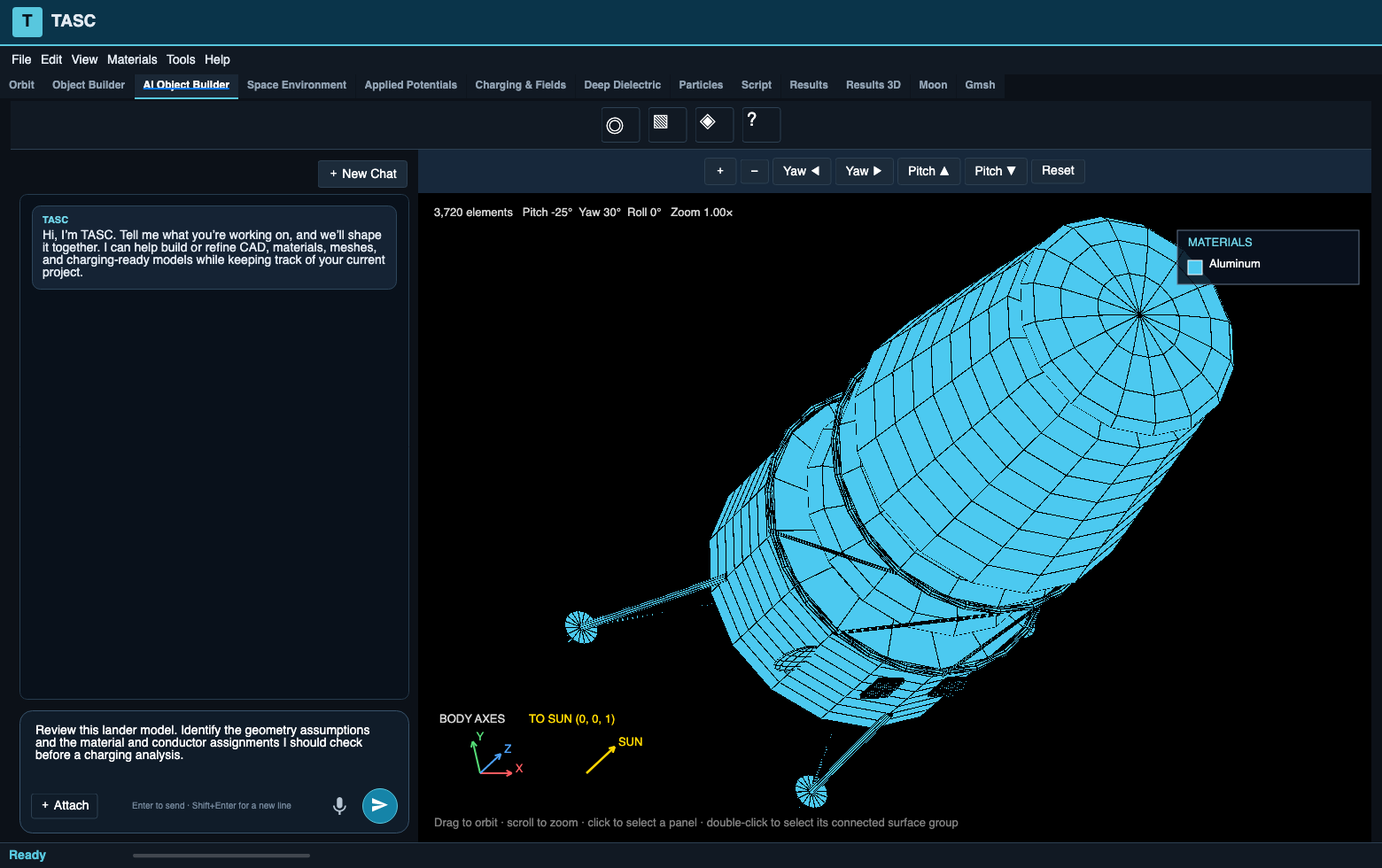
Start with a reference image or a description. TASC’s AI Object Builder supports interpreting geometry, reviewing assumptions, and refining a model before accepting it for further preparation.
“Create a conceptual lander model from this reference image. List the scale and geometry assumptions, then prepare a surface mesh for review.”Illustrative wording for this workflow.
Identify visible shapes and supports. Record estimates for scale, depth, and features that the image does not resolve.
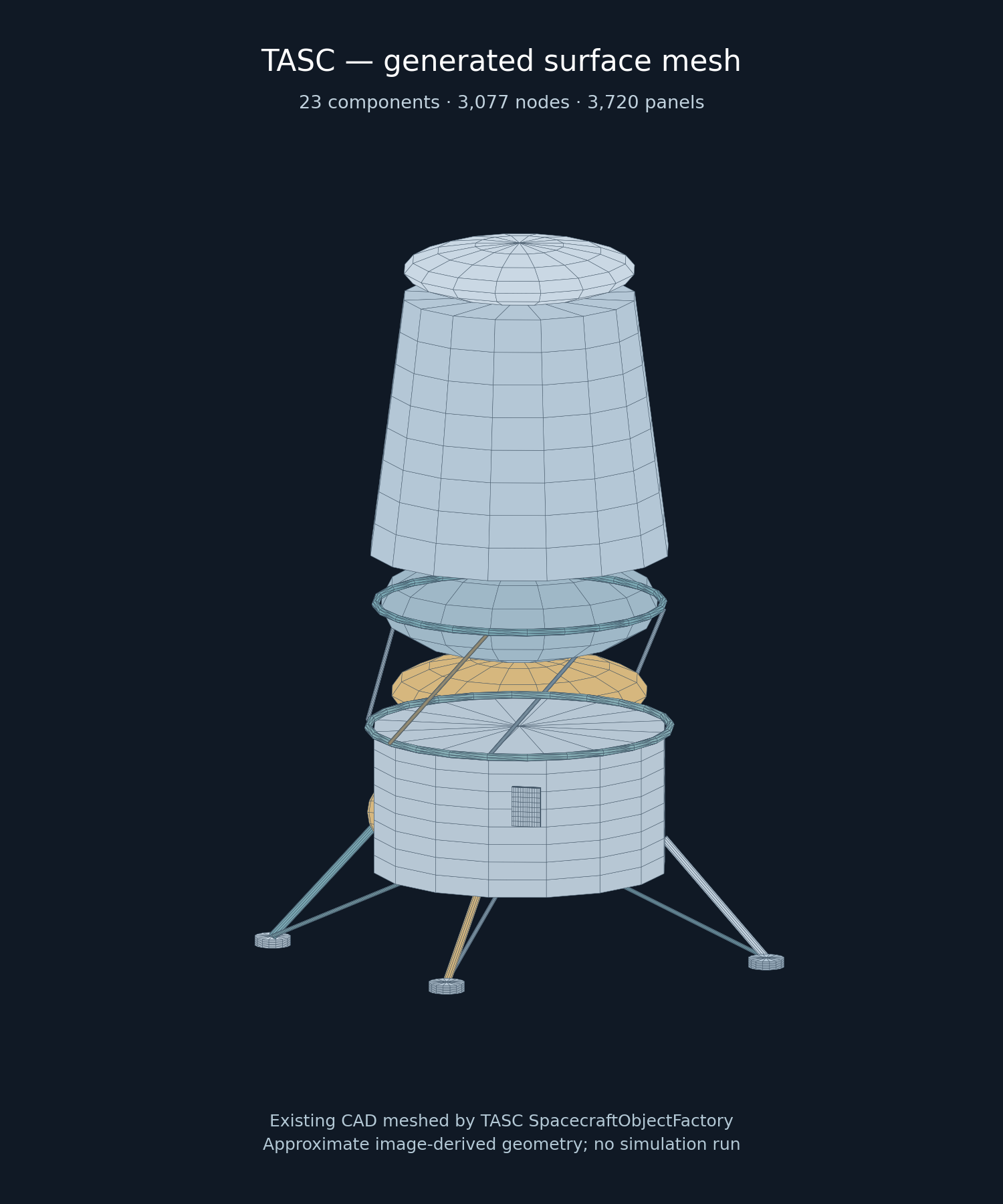
In this saved example, an AI-interpreted concept was compiled locally by TASC into a 23-component lander model.
TASC converted the concept into surface elements. An analyst still needs to review the geometry, assign materials and conductors, and approve the model before analysis.
The saved artifact uses approximate geometry and an assumed 1.8 m person for scale. Hidden structure and some exterior details are omitted. Material assignments are provisional, solver input is not approved, and no charging simulation was run.
Explicit inputs. Inspectable results.
Create or import geometry, prepare charging surfaces, and assign materials and conductors. Keep source CAD distinct from the computational mesh.
GEOMETRY · MATERIALS · MESHINGInvestigate surface charging, electrostatic fields, and internal dielectric charging using the supported numerical methods for each problem.
CHARGING · POTENTIAL · FIELDSReview field maps, charging histories, and diagnostics. Compare configurations and retain the inputs and outputs needed to reproduce a run.
VISUALIZATION · COMPARISON · EXPORTTASC combines independent numerical methods with traceable material data. Each solver has a defined scope; verification focuses on the quantities that matter to the analysis.
Finite-element (MFEM) and boundary-element (BEM) methods support charging and field analysis. The documented MFEM charging path uses CPU Laplace electrostatics and analytic currents; volume plasma space charge, wakes, and plumes are outside that path’s current scope.
Transient internal-charging calculations connect deposited charge, electrostatics, and electrical leakage. This is a separate analysis from spacecraft surface charging, with its own physical inputs and assumptions.
A versioned material catalog retains sources and data status. Analytical checks, convergence studies, and independent solver comparisons provide development evidence. Suitability for a particular engineering decision requires validation of that case and configuration.
Equipotential Lab LLC develops TASC, drawing on experience in spacecraft charging, space plasma environments, and AI. Our development priorities include independent benchmarking, reproducible analysis, and model preparation that keeps the analyst in control.
TASC is an AI-driven spacecraft charging app designed to enable rapid spacecraft charging analysis and save months of engineering work.
Explore TASC